Written by Explore Digital
AI search is changing how people find information, compare options, and make decisions online. So the question is obvious: can ChatGPT Ads eventually compete with Google Ads?
We don’t know yet. ChatGPT ads launched their self-serve platform in May 2026, and so are still a new and rapidly developing channel. And we’re not going to pretend a few months of platform history can give us a permanent answer.
OpenAI currently allows ads to appear for U.S. adults using its Free and lower-cost Go plans. Plus, Pro, Business, Enterprise, and Education accounts remain ad-free. So ads aren’t technically limited to nonpaying users, since Go is a paid plan, but the available audience is concentrated heavily among free and lower-cost accounts.
There’s no verified public breakdown of free versus paid ChatGPT accounts specifically in the U.S. However, EMARKETER forecasts that nearly three-quarters of the 152.9 million U.S. generative AI users use ChatGPT, which works out to approximately 115 million people. OpenAI has also reported that roughly 95% of its global users use ChatGPT for free. If the U.S. audience follows a similar split, that would suggest approximately 109 million free users and 6 million paid users. That’s an estimate, not a disclosed U.S. account count, but it shows the scale of the ad-supported audience.
This is Part 1 of a two-part experiment. Before we run a real-world test, we’re putting our hypothesis on the table. We’re looking at user behavior, search intent, buyer psychology, ad placement, and the way people use each platform.
Then, in Part 2, we’ll compare our predictions against actual campaign data.
One important caveat: this article is a snapshot of the platforms as they exist in July 2026. OpenAI is still adjusting its ad products, placements, audience rules, and advertiser tools. At the same time, Google is introducing Gemini-built Search ad formats and expanding AI-powered campaign features. The platforms may look significantly different by the time we publish our test results.
Our hypothesis is based on where ChatGPT Ads and Google Ads are today, not where either platform will stay forever.
Why ChatGPT Ads Are Getting Attention
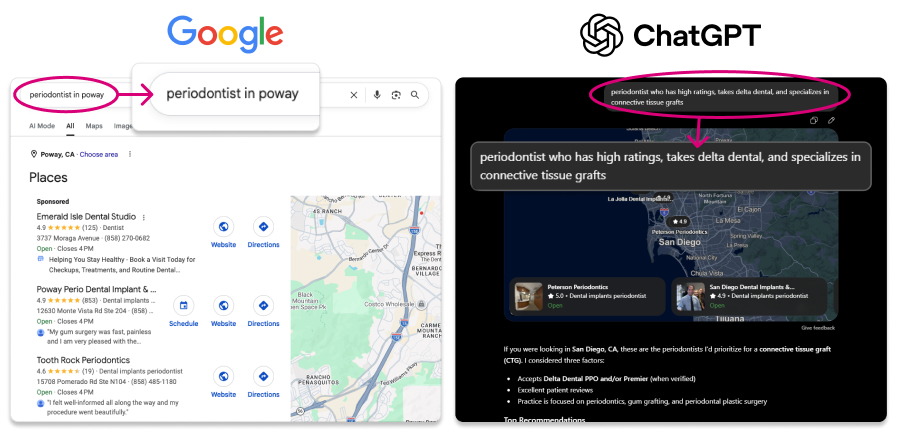
For years, Google has been the default answer for paid search. Someone needs a plumber, a dentist, a lawyer, a software tool, or a local service. They search. Ads appear. The user clicks, calls, books, or buys.
That model still works because the behavior is clear.
But ChatGPT introduces a different kind of search behavior. People don’t just type a short query and scan links. They ask detailed questions (long-tail search). They explain their situation. They compare options. They ask for follow-ups. They use the platform to think through a decision.
That’s why we’re paying attention to advertising in ChatGPT.
If an ad can show up during a relevant conversation, it has the potential to feel more useful than a standard display ad or cold interruption. Instead of catching someone between tasks, ChatGPT Ads may reach people while they’re actively trying to solve a problem.
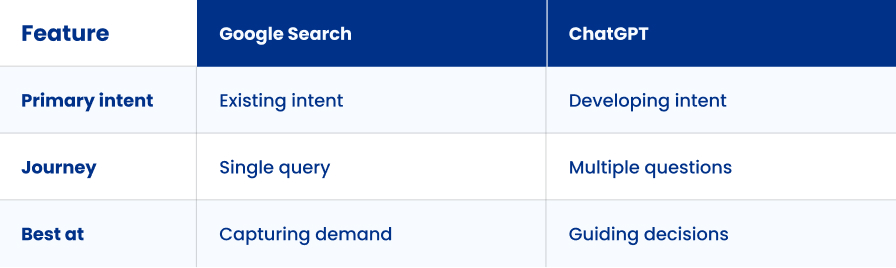
That could be valuable. But it also creates a very different challenge. Google Ads usually captures demand that already exists. Where we predict that ChatGPT Ads will shine is that they can influence demand while someone is still shaping the decision. Those aren’t the same jobs.
The Core Difference: Search Intent vs Conversation Intent
When we compare ChatGPT Ads vs Google Ads, the first thing we care about is intent.
Google is still very strong at direct-response advertising because people often use it when they know what they want. A search like “emergency HVAC repair near me” or “best pediatric dentist in San Diego” isn’t casual browsing. That person is close to taking action.
That’s why Google Ads has been so effective for lead generation. It lets businesses appear when someone is already looking for what they offer.
ChatGPT is different because one conversation can move through several types of intent.
A user could begin with a broad informational question:
“Why does my water heater keep running out of hot water?”
That’s an awareness-stage conversation. The person knows there’s a problem but may not understand the cause or know what kind of service they need (if any).
They could then move into consideration:
“Is it worth repairing, or should I replace it?”
“Which type of water heater lasts the longest?”
“Do tankless water heaters save enough money to justify the cost?”
Now they’re comparing solutions, costs, and tradeoffs. They’re further down the funnel, but they still aren’t necessarily choosing a business.
Then the conversation could become commercially focused:
“Who’s the top-rated plumber in my town for water heater replacement?”
“Which companies offer financing?”
“Can I get this installed this week?”
At that point, the user may be close to taking action. But instead of expressing that intent through a series of separate searches, they’ve developed it across one continuing conversation.
That creates several potential roles for ChatGPT Ads:
- Awareness: Reaching someone who’s still identifying or understanding a problem
- Consideration: Helping someone compare solutions, services, or approaches
- Commercial investigation: Appearing while someone evaluates providers, features, prices, or reviews
- Conversion: Giving a ready-to-act user a direct path to call, book, request a quote, or buy
Google can reach people across these stages too, especially as Search becomes more conversational. But Google Ads has historically been strongest when intent is already clear and can be tied to a specific query.
ChatGPT may provide richer context because it can see how the user arrived at the question. The tradeoff is that much of that activity may happen earlier in the customer journey.
That doesn’t make the traffic bad. It means the campaign has to be judged based on the role it plays.
An awareness-stage ChatGPT campaign shouldn’t be expected to generate the same immediate cost per lead as an emergency-service Google Search campaign. It may instead influence later branded searches, repeat visits, content downloads, assisted conversions, or eventual vendor selection.
If Google is often the “I’m ready to act” platform, ChatGPT may span everything from “help me understand this” to “help me decide” and, in some cases, “help me choose who to hire.”
Our Prediction: Google Ads Will Win on Direct Leads
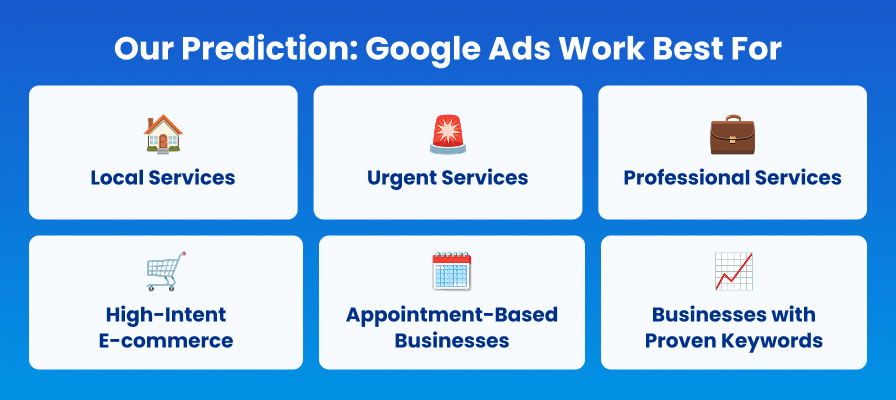
Our first hypothesis is simple: Google Ads will outperform ChatGPT Ads for direct lead generation in most service-based campaigns.*
That doesn’t mean Google Ads will always be cheaper. Competitive industries can get expensive fast. Legal, dental, home services, finance, B2B, and healthcare can all have high cost-per-clicks because the leads are valuable.
But Google still has one major advantage: timing.
When someone searches for a service on Google, they’re often closer to the decision point. They’re looking for providers. They’re comparing businesses. They’re ready to call, book, buy, or fill out a form.
We think that’s more important than novelty. A new ad platform can be interesting, get attention, and produce strong engagement. But if the user isn’t ready to act, the campaign may struggle to beat Google on cost per lead, booked calls, or revenue.
That’s why we expect Google Ads to remain the stronger direct-response channel in the near term.
Our prediction is especially strong for:
- Local services
- Urgent services
- Appointment-based businesses
- High-intent e-commerce searches
- Professional services with clear search demand
- Businesses that already know their best-performing keywords
For these businesses, paid search advertising still gives you a direct path to people who are already looking.
Where ChatGPT Ads Could Perform Better
Now for the other side.
ChatGPT Ads may not beat Google on immediate lead generation, but they could perform well in areas where the buyer needs more education before taking action.
That includes complex purchases, high-consideration services, and industries where trust matters.
Think about a business owner comparing marketing agencies. They may not start with “best PPC agency near me.” They might start with:
“What should I look for in a digital marketing agency?”
“Why are my Google Ads getting clicks but no leads?”
“Should I invest in SEO or paid ads first?”
“What questions should I ask before hiring a marketing company?”
Those are valuable conversations. They’re just not always bottom-of-funnel searches.
This is where ChatGPT Ads could have an advantage. If the platform can understand the user’s context and surface a relevant advertiser at the right moment, the ad may feel more like a helpful next step than a hard interruption.
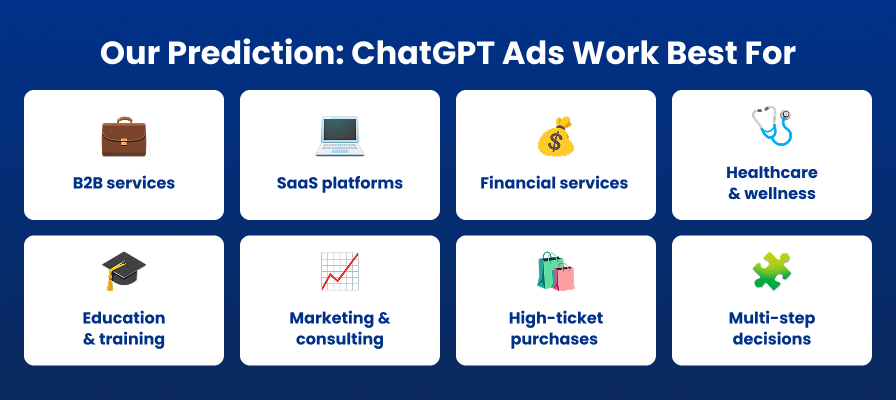
That could work well for:
- B2B services
- SaaS platforms
- Financial services
- Healthcare and wellness
- Education and training
- Marketing and consulting
- High-ticket consumer purchases
- Multi-step buying decisions
These are categories in which buyers ask questions before choosing. If ChatGPT Ads can support that decision-making process without disrupting trust, they could become a serious channel.
Not a Google replacement. A different role in the funnel.
The Biggest Challenge for ChatGPT Ads: Trust
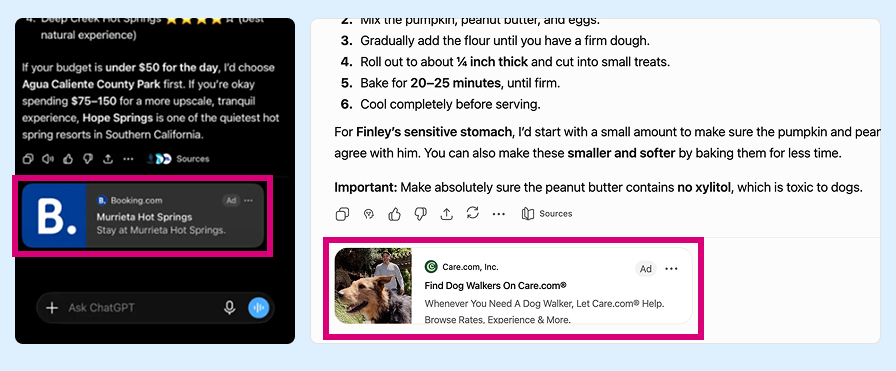
ChatGPT’s greatest strength may also be its biggest ad challenge.
People use ChatGPT because they want help. They ask personal, detailed, and sometimes sensitive questions. They expect the answer to be useful and without bias.
That means the ad experience has to be handled carefully. If users feel like sponsored placements are shaping the answer, trust drops. If ads feel too aggressive, the platform starts to feel less useful. If the ad is poorly matched to the conversation, it creates friction instead of value.
That’s the risk.
On Google, people already understand the ad model. They know sponsored results appear at the top. They can compare ads, organic results, map listings, reviews, and business websites. The commercial layer is obvious.
In ChatGPT, though, the ad layer has to fit inside a conversation.
That makes relevance and transparency more important than ever. If the ad is clearly labeled, useful, and aligned with the user’s goal, it may work. If it feels like the answer is being bent toward the advertiser, users will push back.
For businesses, that means ChatGPT Ads will likely require a different mindset. The best-performing campaigns may not be the loudest. They may be the most helpful.
How Mobile and Desktop Use Could Change Results

Device usage could create another meaningful difference between ChatGPT Ads and Google Ads.
ChatGPT has a substantial audience across both its desktop experience and mobile app. Sensor Tower estimated that the ChatGPT mobile app reached one billion monthly active users globally in June 2026. But a large mobile audience doesn’t mean those users will behave the same way as someone sitting at a computer.
On desktop, we expect users to be more likely to:
- Conduct longer research sessions
- Compare multiple providers or solutions
- Open supporting pages in separate tabs
- Complete longer forms
- Research B2B, software, financial, or high-consideration services
- Move between ChatGPT, Google, review sites, and business websites
That environment may give ChatGPT Ads a better opportunity to influence complex decisions.
Mobile behavior may be faster and more immediate. Someone could use ChatGPT through voice, upload a photo, ask for a nearby recommendation, or look for a quick answer while away from a computer.
But mobile also creates more conversion friction. A slow landing page, long form, difficult navigation, or unclear CTA can lose the user quickly.
Google already has a mature mobile advertising system built around calls, maps, directions, local results, shopping listings, and immediate actions. That could give Google Ads an advantage for urgent and location-based searches.
The advantage ChatGPT has with mobile ads may be the fact that users provide more context about their intent and need. Google’s advantage may be how quickly it connects that intent to a familiar action.
That’s why we don’t want to blend all device data together. Our test will compare mobile and desktop performance separately, including differences in click-through rate, landing page behavior, lead quality, conversion rate, and cost per lead.
The Metrics We’ll Watch
To compare ChatGPT Ads vs. Google Ads fairly, we can’t only look at clicks.
Clicks are important, but they don’t tell the whole story. A platform can generate cheap clicks and still produce weak leads. It can also produce fewer clicks but stronger assisted conversions later.
We’ll divide the metrics into two groups.
Primary Business Metrics
These metrics will help determine which platform produces stronger business results:
- Number of leads
- Conversion rate
- Cost per lead
- Qualified lead rate
- Booked call rate
- Cost per booked call
- Sales opportunities
- Attributed revenue
- Return on ad spend
Secondary Performance Metrics
These metrics will help explain why each platform performed the way it did:
- Impressions
- Click-through rate
- Cost per click
- Landing page engagement
- Time on site
- New versus returning visitors
- Mobile versus desktop performance
- Assisted conversions
The primary metrics will tell us which platform produces the stronger outcome. The secondary metrics will help us understand how users behaved before reaching that outcome.
The most important metric depends on the business.
For a local service company, the cost per booked appointment may be most important. For B2B, lead quality and sales opportunity rate may matter more than form volume. For e-commerce, the real test is revenue and profit, not just traffic.
That’s why we don’t want to declare ChatGPT Ads successful based on a vanity metric like engagement alone. Engagement can help explain performance. It can’t replace revenue.
How We’d Structure a Fair Test
A fair test has to compare the platforms based on the job they’re supposed to do.
We’re not going to run a high-intent Google Search campaign against a broad ChatGPT awareness campaign and pretend the result is meaningful. That would stack the deck.
Instead, we’re building a test around the same business goal and tracking how each channel contributes.
That test has to include:
- A clear offer: Both platforms need to send users toward the same core action, like booking a strategy call, requesting a quote, downloading a guide, or starting a trial.
- Dedicated landing pages: Each platform should have its own landing page or tracked URL so we can compare behavior cleanly.
- Proper conversion tracking: Forms, calls, bookings, purchases, and qualified leads need to be tracked. Otherwise, we’re guessing.
- Lead quality review: Not all leads are equal. We’d review which leads were real, qualified, reachable, and tied to an actual business opportunity.
- Enough budget to learn: A tiny spend test can create noise. The test needs enough data to spot patterns without pretending early results are final.
This is the same reason we don’t treat any new marketing channel like a magic button. A channel only matters if it fits the business, the buyer, the offer, and the numbers.
That’s how we approach digital marketing strategy in general. Not “be everywhere.” Be where the buyer is, with the right message, at the right point in the decision.
What This Means for Businesses Running Google Ads Now
If Google Ads is already working for your business, we wouldn’t recommend pulling your current ad budget just to chase ChatGPT Ads.
Instead, we recommend protecting what’s working while testing new channels carefully. Use 5-10% of your budget for testing. Keep the campaigns that generate qualified leads. Improve tracking. Tighten landing pages. Watch lead quality. Then test emerging platforms with a controlled budget and a clear hypothesis.
That way, you’re not risking proven revenue to fund an experiment.
For businesses that have struggled with Google Ads, ChatGPT Ads may still be worth watching. But it won’t fix a weak offer, a confusing landing page, poor tracking, or an unclear sales process.
New channels don’t solve old marketing problems. They usually expose them faster.
What Advertisers Should Watch Next

The future of digital advertising won’t be Google Ads vs AI advertising in a simple winner-takes-all fight. It’ll be more layered than that.
Google is already adding more AI into Search. ChatGPT is building ad tools. Other AI search platforms will continue testing monetization models. Users will keep shifting between search engines, AI assistants, social platforms, video, maps, marketplaces, and brand websites.
That means businesses need to understand the role each channel plays. Some channels capture demand. Some create demand. Some build trust. Some close the sale. Some keep you visible while buyers take their time.
The mistake is expecting every channel to do the same job. We hypothesize that ChatGPT Ads will become useful, especially for education-heavy and high-consideration buying journeys. But for now, we expect Google Ads to remain the stronger platform for bottom-of-funnel lead generation.
Part 2 will show whether the data agrees.
Our Official Prediction Before Testing
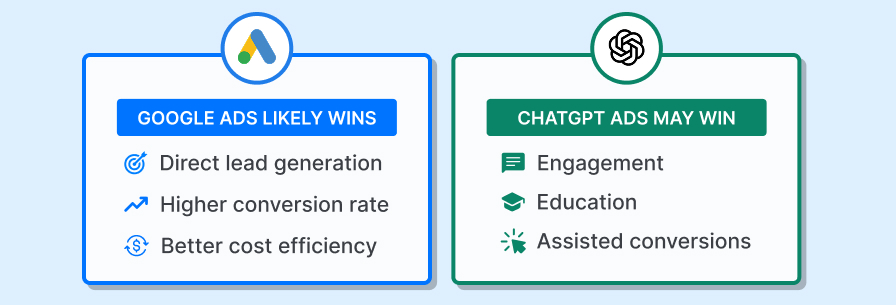
We predict that Google Ads will keep winning where intent is clear and immediate. ChatGPT Ads have real potential, but we don’t expect them to replace Google Ads any time soon.
Google Ads will outperform ChatGPT Ads on: direct lead generation, conversion rate, and cost efficiency for high-intent campaigns.
ChatGPT Ads will perform better on: engagement, awareness, and possibly assisted conversions for high-consideration purchases.
In plain English: Google will likely win when someone is ready to act. ChatGPT may win when someone is still deciding what action to take.
We also expect ChatGPT Ads to have a stronger learning curve. Advertisers won’t be able to simply copy their Google Ads strategy and expect the same result. The user behavior is different, so the message, offer, landing page, and success metrics need to be different too.
A “Book Now” ad may work on Google.
In ChatGPT, though, CTAs like “Compare your options,” “Get a checklist,” or “See what to ask before hiring” might perform better because the user is at a different stage of the buyer journey. ChatGPT Ads will likely matter more in the earlier stages of the decision, where users are asking questions, comparing options, and building confidence.
So in Part 2, we’re testing, tracking, and sharing where the results say each platform fits in the customer journey and how to measure whether it’s actually helping the business grow.
If you’re already spending on ads and want a clearer view of what’s working, talk to us. We’ll help you make sense of the numbers before you throw more budget at the wrong problem.
Frequently Asked Questions About ChatGPT Ads vs Google Ads
1. What are ChatGPT Ads?
ChatGPT Ads are advertisements shown within the ChatGPT experience. They may appear as sponsored placements, contextual recommendations, or other ad formats designed to fit naturally within a conversation.
2. How are ChatGPT Ads different from Google Ads?
Google Ads responds to search queries. ChatGPT Ads appear within a conversational experience where users may be researching, comparing, or asking for help with a decision. That means the user’s mindset can be very different.
3. Will ChatGPT Ads outperform Google Ads?
We predict that Google Ads will outperform ChatGPT Ads for direct lead generation in the near term. ChatGPT Ads may perform better for education, awareness, and high-consideration buying journeys.
4. Why might Google Ads still perform better?
Google captures people when they’re actively searching for a product, service, or provider. That immediate intent often leads to stronger conversion rates and clearer cost-per-lead data.
5. Could ChatGPT Ads work better for certain businesses?
Yes. ChatGPT Ads may work well for businesses where buyers need education before they act. That includes B2B services, SaaS, healthcare, financial services, consulting, education, and higher-ticket purchases.
6. Are ChatGPT users more engaged than Google users?
Often, yes. ChatGPT conversations can be longer and more detailed than a standard search. But higher engagement doesn’t automatically mean more leads or sales.
7. What metrics should businesses track?
Businesses should track impressions, clicks, click-through rate, conversion rate, cost per lead, qualified lead rate, booked call rate, sales opportunities, and return on ad spend. Lead quality matters as much as lead volume.
8. Will AI advertising replace PPC?
When it comes to PPC vs AI advertising, we don’t expect AI ads to replace PPC. It’s more likely to become another layer in the marketing mix, especially as AI search and conversational platforms become more common.
9. Should businesses test ChatGPT Ads now?
Businesses with strong tracking, clear offers, and room for testing should watch the channel closely. Businesses still struggling with basic campaign tracking or lead quality should fix those issues before adding another platform.
10. When will Part 2 be published?
Part 2 will be published after we complete a controlled ChatGPT Ads vs Google Ads test and compare the results against the predictions in this article.